


when i first started my fitness journey, i spent about two years training like someone who really wanted results, but getting almost none. five sessions a week, rarely missing one, sore most days, and barely seeing my weights go up.
i know now that part of the problem was food. i simply wasn’t eating enough to build anything, which is a story i’ve told before. the other part was much simpler, and nobody had ever explained it to me. i was doing the same workouts, with the same weights, month after month. my body had no reason to change, so it didn’t.
what changed the game for me was understanding progressive overload and actually applying it to my workouts. when you put it like that, it sounds like a complex concept, but it’s actually much simpler than you think. if you googled it right now, you’d probably understand the basic idea pretty quickly. the problem is that most of what you’ll find stops at the definition. which isn’t much help when you’re standing in front of a dumbbell rack, trying to figure out what you should actually pick up.
this guide starts at the definition and then gives you the rules you run every week: what to write down, which number you’re trying to beat today, when to add weight, how much to add, and what to do when the plan stops being obvious.
disclaimer
this guide assumes you already have a program, meaning a fixed set of exercises you repeat each week. if you don’t have one yet, read "how to program your workouts the smart way" first, then come back here. progressive overload is what you apply to a program. it isn’t a program by itself.
this is educational content, not medical advice. if you have a medical condition, are pregnant or breastfeeding, are recovering from an injury, or have a history of disordered eating, talk to a doctor before starting or changing a training program.
part 1. what progressive overload actually is
progressive overload means asking your body to do slightly more than it’s already comfortable with, over and over, for a long time.
your body is efficient. muscle is expensive tissue to build and expensive to carry around, so your body keeps only the amount it currently needs. training is how you tell it the current amount isn’t enough. you lift something hard, you create a demand it can’t quite meet, and during the days that follow it repairs the tissue and adds a little capacity on top, in case the same thing happens again.
once that capacity is built, the same workout stops being a demand. the weight that was hard in january is just a normal tuesday in march. your body has already adapted to it and has nothing left to gain from doing it again.
this is why women who train four or five times a week for a year sometimes look and feel exactly the same as when they started. they’re working. they’re just working at a level their body sorted out months ago.
the five ways to do more
five things can go up in a session:
the weight on the bar,
the reps you get with it,
the sets you do,
the sessions you train per week,
and the quality of each rep (meaning a fuller range of motion and more control on the way down).
sets and sessions hit a ceiling faster than most people think. more sets means more fatigue to recover from, and you only recover so fast. more sessions means more hours you probably don’t have. piling those on is the most common way a motivated woman ends up exhausted and stuck.
the two levers you’ll actually use every week are reps and weight. quality sits underneath both as a condition rather than a variable you play with.
the condition that makes all of this work
none of this matters if your sets are easy.
the measure most coaches use is RIR, which stands for reps in reserve. it’s the number of clean reps you could still have done when you stopped the set. if you finish a set and you’re sure you had three more in you, that’s 3 RIR. if you couldn’t have done a single extra rep, that’s 0 RIR, also called failure.
for building muscle, how close you get to failure matters. a 2024 series of meta-regressions covering dozens of studies found that muscle growth improved as sets were taken closer to failure, while strength gains were much less sensitive to it (Robinson et al., 2024). meaning: if you’re stopping every set with five reps left in the tank, adding a rep next week isn’t progress. you were never near your limit in the first place, so there was no demand to increase.
most of your working sets should land at 1 to 3 RIR. on the set where you’re attempting a new best, 0 to 1 RIR is the point.
part 2. why training hard isn’t the same as progressing
these are the three messages i get most often from readers:
“i’m lost. i train four times a week and i feel like it’s not working. is that even enough?”
“i can’t get my lifts to go up even though i train four or five times a week. why?”
“i’m eating enough, i’m training four times a week, and i’m still not gaining muscle. i don’t understand.”
when i actually talk to these women, the pattern is almost always the same: very long sessions, eight or ten exercises, constantly sore, and never fully recovered. so no session is ever performed at real intensity. there’s also no record of anything, which means no one, including them, can tell whether the work is going anywhere.
a session can leave you wrecked and still be identical to the one you did last month. how hard it felt tells you very little, because your sleep, your stress, your last meal and where you are in your cycle all change how the same weight feels on a given day. the only reliable signal is what you wrote down.
if you’re not tracking, you’re not progressively overloading
you can’t beat a number you don’t know. this is the whole reason progressive overload fails for most people. they understand the concept perfectly and then walk into the gym and pick up whatever dumbbells they used last time, more or less, for however many reps feels right, more or less.
tracking takes about ninety seconds per session and you just need four things:
the exercice you did,
the weight you used,
the reps you got on each set,
and optionally how hard it felt in RIR.
a notes app or a paper notebook does the job, and apps like strong or hevy are built for it and make the history easier to read.
the part people get wrong is recording only their best set. write down every set.
part 3. why you add reps before you add weight
there are two dials in front of you, weight and reps. the method in this guide moves one at a time, in a fixed order: reps first, weight second, then back to reps. trainers call this double progression, because you’re progressing on two variables in sequence rather than trying to push both at once.
there are four reasons i recommend it to every beginner.
1. the weight jumps available to you are too big
in a perfect world you’d add 200 grams to the bar each week and progress forever. real gyms don’t work that way.
the smallest plate in most gyms is 1.25 kg, so the smallest barbell jump is 2.5 kg. dumbbells usually go up in 2 kg steps. a machine stack often jumps 5 kg per pin, sometimes 7.
now run the numbers. adding 2.5 kg to a 60 kg leg press is a 4% increase, which is manageable. adding 2 kg to an 8 kg dumbbell shoulder press is a 25% increase. there is no world in which you add 25% to a lift every week. try it and you’ll fail the set, get discouraged, and conclude you’re not progressing, when the real problem is that the gym only sells you progress in chunks that are too large.
reps are the small change that lets you close the gap between one dumbbell and the next.
2. you always know exactly what to beat
this is the underrated part. when you walk in and your log says 8 kg, 9 reps, 8 reps, 8 reps, your job today is obvious. get ten on the first set. no deciding, no guessing, no scrolling through your phone between sets wondering whether you should go heavier. beginners abandon programs because they’re boring or because they’re confusing, and a single clear target each session removes the second problem.
3. it tells you when something else is wrong
when you can’t add a single rep, anywhere, for three weeks running, that’s information. it usually means you’re not eating enough, not sleeping enough, or carrying more volume than you can recover from. without a log, that signal takes six months to reach you.
4. it’s backed by research
a 2022 study put this to the test directly. researchers took 43 trained lifters, men and women, and ran them through the same lower body program twice a week for eight weeks. one group was told to increase the load while staying in an 8 to 12 rep range. the other group was told to keep the same load and increase the reps (Plotkin et al., 2022).
muscle growth was essentially the same in both groups. squat strength favored the load group by about 2 kg, a difference the authors themselves described as of questionable practical significance.
i want to be honest about what that does and doesn’t say. it doesn’t mean weight never needs to go up. over months and years, load has to increase, and that small strength edge is real. what it says is that adding reps to a fixed weight is a legitimate way to drive muscle growth, not a lesser substitute for adding plates. this is why the reps-first approach holds up: you’re building muscle the whole time you climb through the rep range, and the weight increase arrives at the end of it.
one full example, start to finish
let’s run it on a dumbbell shoulder press.
three working sets
rep range of 8 to 12
starting with 8 kg dumbbells
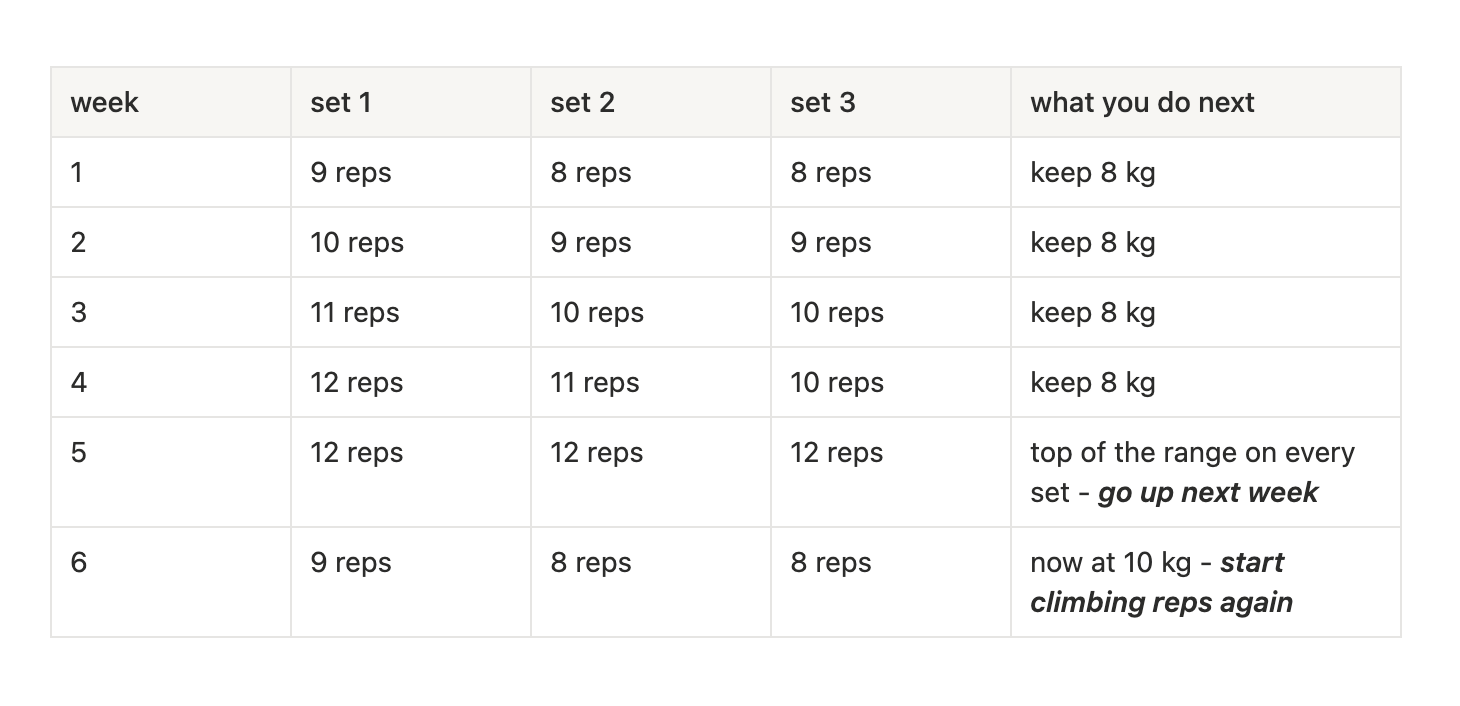
look at week 6 → your reps collapsed back to where you started in week 1, which feels like going backwards and is in fact the opposite. in week 1 you pressed 25 reps with 8 kg, so 200 kg of total work. in week 6 you pressed 25 reps with 10 kg, so 250 kg. that’s 25% more work done in five weeks, with no dramatic sessions and nothing that required motivation.
five weeks to change dumbbells sounds slow but run that pattern for a year on every exercise in your program and you’ll be a genuinely different lifter.
the rest of this guide is for ✨ paid subscribers ✨
everything above is the concept and the reasoning. what follows is the method:
step 1, your rep range: how to pick one for every exercise in your program, and why the right range is different for a squat and a lateral raise
step 2, your starting weight: the one-set test that tells you where to begin, so you don’t waste a month training too light
step 3, the rule you follow every session: the exact decision, what counts as a rep, and the mistake that lets you add reps for months without building anything
step 4, when and how much weight to add: increments for barbells, dumbbells, machines and cables, plus what to do when the only jump available is far too big
a full training block on paper: four exercises tracked across six weeks, with the flat weeks left in, because that’s what real logs look like
the situations that confuse everyone: sloppy reps, missed weeks, fixed weight stacks, bodyweight exercises, one side weaker than the other, your cycle, and what to do when the reps go backwards
training at home with limited equipment: how far you can push this with two dumbbells and a band, and the point where you’ll need more