


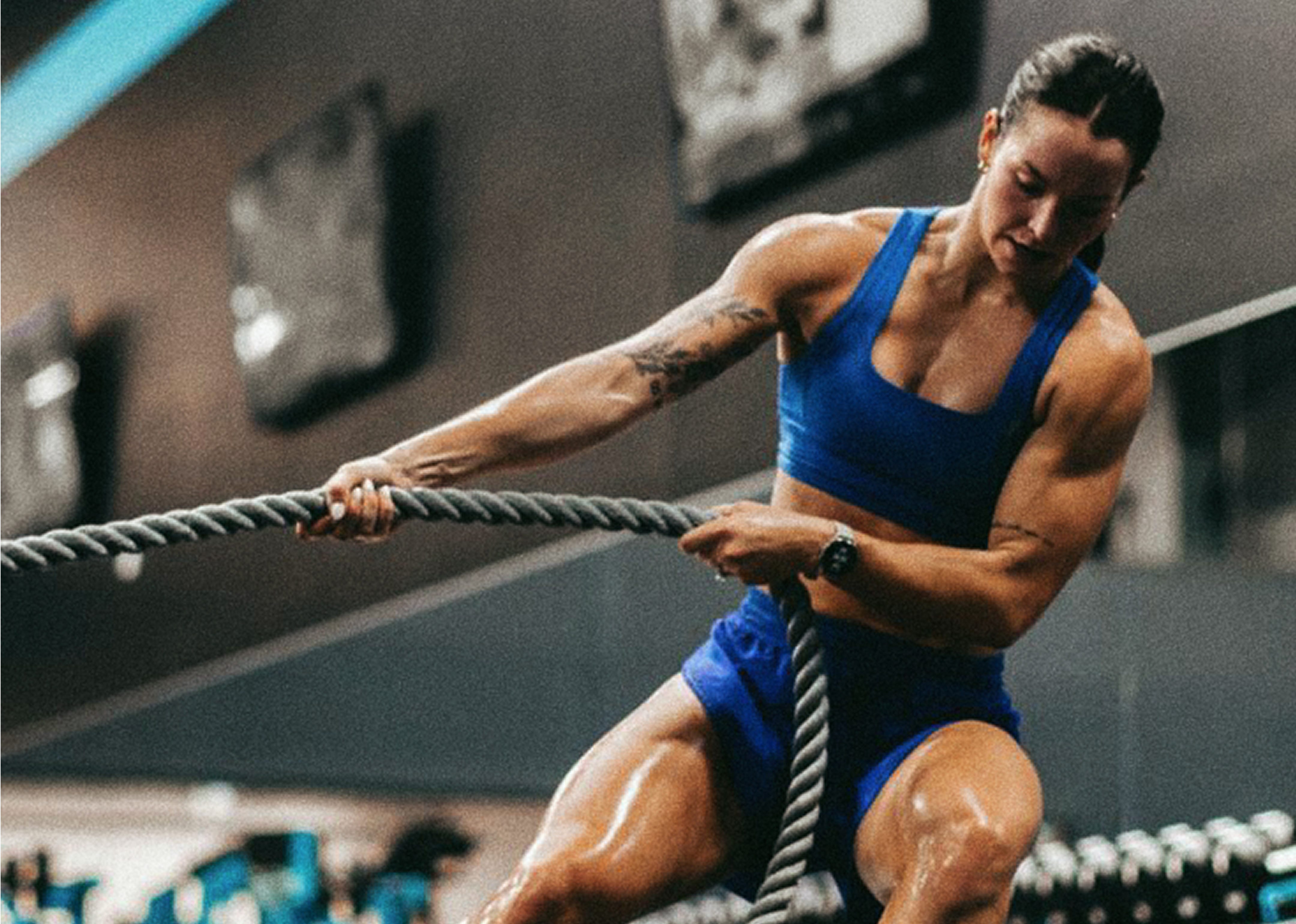
My grandma was the strongest woman I knew. Not in the gym sense. She never touched a barbell in her life. But she was the kind of woman who ran her own world. Independent, sharp, always moving, always doing something. She raised me, and for the longest time, I thought she’d just be like that forever.
Then she got sick. And she never recovered.
She spent the last five years of her life in a bed. Five years. The woman who used to do everything for herself couldn’t get up, couldn’t walk, couldn’t do the small things that made her who she was. I was 15 when it happened. I didn’t understand it the way I do now. At that age, you just feel the sadness of it without being able to put words on what it actually means.
The real shift came years later, when I saw other people in my family go through the same thing. Losing their independence, spending their final years unable to do the things they loved. That’s when I started connecting the dots between an active lifestyle, strength, and what kind of life you get to have when you’re older. I stopped thinking about fitness as something that existed to make me look a certain way and started seeing it for what it really is: a way to stay free and live on my own terms for as long as possible.
This conversation is happening a lot more in the fitness world right now, and I think it’s one of the most important shifts we’ve seen in a long time.
💌
never not hungry is a reader-supported publication. to receive new posts and support my work, consider becoming a free or paid subscriber.
the longevity conversation is not just a trend
If you’ve been on social media lately, you’ve probably noticed that longevity is everywhere. Podcasts, books, influencers talking about optimizing your healthspan. Some of it is genuinely useful. Some of it is rich people spending thousands on blood panels and hyperbaric chambers. But underneath all the noise, there’s a real and important idea.
The choices you make now about how you move and eat will directly shape the quality of your life decades from now.
And here’s what keeps coming up in almost every serious conversation about longevity: strength training. Resistance training, specifically, keeps showing up as one of the most powerful tools we have for aging well. The research behind this is not new, but the mainstream attention it’s getting definitely is. And frankly, it’s about time.
I have to be honest, I’ve become a bit obsessed with this topic lately. A big part of that started with reading Outlive by Peter Attia. I don’t usually pick up non-fiction unless it’s something I genuinely can’t stop thinking about, and longevity had been on my mind for a while already. In the book, Attia breaks down what he calls the “Four Horsemen” of aging (heart disease, cancer, neurodegenerative disease, and type 2 diabetes) and makes a case for a completely different approach to health. Instead of waiting until something breaks and then trying to fix it, he argues we should be building strength, metabolic health, and cardiovascular fitness now, as a strategy to prevent those diseases from taking over later. Exercise, and strength training in particular, is at the center of everything he recommends.
Reading it only made me want to keep digging. I love understanding the science behind how our bodies work, especially when it comes to health. And the upside is that I get to break it all down for you so you don’t have to sit through the boring graphs and complicated data.
So let’s get into what actually goes on in your body over time, because most people don’t think about this until it’s already a problem. I’ll keep it as simple as I can. The goal here is for you to understand the tools that can help you live a better and longer life, in a way that feels manageable and doesn’t turn into a full-time job.
what happens to your muscles as you age
Stay with me. I know this part is a lot of science, but I promise it's important if you want to live a better and longer life.
Starting around age 30, your body begins to lose muscle mass. The rate is roughly 3 to 5% per decade.1 That might not sound like much when you’re 35. But by the time you reach your 70s and 80s, it adds up fast. Some research suggests that by the eighth decade of life, people can lose up to 50% of their muscle mass.2 That’s not just about looking different. That’s about your body literally not being able to do its job anymore.
This process has a name: sarcopenia. And it doesn’t just affect how strong you are. It’s connected to a whole cascade of problems. Lower metabolic health, higher risk of falls, loss of independence, and higher mortality.3
Muscle isn’t the only thing that weakens over time. Bone density decreases too, and this is especially relevant for women. After menopause, the drop in estrogen accelerates bone loss significantly. Osteoporosis and osteopenia become real risks, and with them comes a much higher chance of fractures. A hip fracture in an older adult is not a small thing. It can be the beginning of a rapid decline in overall health and independence.
Resistance training directly addresses this. When you lift heavy things, you’re not just building muscle. You’re putting mechanical stress on your bones, and your bones respond by getting denser and stronger. This isn’t a marginal benefit. For women who are approaching or past menopause, this is one of the most effective non-pharmaceutical tools available for protecting bone health.4
the fitness industry failed women
This part frustrates me because it's barely talked about, and when someone does address women in perimenopause or menopause, it's usually to sell them some b.s. protocol with zero evidence behind it.
When women go through menopause, their bodies start losing muscle at a much faster rate than before. Estrogen, testosterone, and growth hormone drop—and all of that makes the body way more vulnerable to losing the muscle it already has. By the time women reach late postmenopause, a significant number of them are already dealing with real muscle loss.5 And most of them have no idea, because nobody warned them.
Think about that for a second. Women are going through one of the biggest physical transitions of their lives, and the mainstream fitness industry’s response is... more cardio. Eat less. Get smaller. Buy this detox tea. Do this 1200-calorie meal plan.
The messaging women receive about their bodies has almost nothing to do with their actual health. It’s built around aesthetics, around shrinking, around taking up less space. And it completely ignores what’s actually happening inside.
Nobody is telling women in their 30s and 40s to start building as much muscle as they can before menopause hits. Nobody is explaining that the muscle you carry going into that transition is like a safety net, that the more you have, the more you get to keep. Instead, women are sold the idea that being small is the goal, when their bodies are literally begging them to get stronger.
And here’s what makes it even more frustrating. The science on strength training and longevity is overwhelming. Research consistently shows that resistance training significantly lowers the risk of dying from pretty much everything, including heart disease, cancer, and all-cause mortality.6 Not by a tiny margin either. We’re talking about meaningful, measurable reductions in risk. When you combine strength training with aerobic exercise, the protective effect gets even stronger.7
Less than an hour of resistance training per week is already enough to make a real difference. And yet, so many women still avoid the weight room because the industry told them that lifting heavy would make them “bulky” instead of telling them it could literally extend their life.
If these results came in a pill, every doctor on the planet would prescribe it.
how to make it work in real life
I know. You just read a lot of science and your brain is probably going “cool, but what do I actually do.” Fair enough. The good news is that you don’t need to train like an athlete or spend three hours a day at the gym. You just need to be intentional and consistent.
If you’re starting from zero or coming back after a long break, here’s a realistic way to build a routine that covers all the bases.
1. strength training, 3 times a week
This is the non-negotiable. Full body sessions or an upper/lower split, whatever works for your schedule. Focus on compound movements like squats, deadlifts, rows, presses, and hip hinges. These exercises work multiple muscle groups at once and give you the most bang for your time. You don’t need to lift crazy heavy right away. Start with weights that feel challenging but manageable for 8 to 12 reps, and build from there.
🎯 Progressive overload (gradually increasing the weight, reps, or sets over time) is what tells your body to keep adapting.
2. zone 2 cardio, 2 to 3 times a week, 30 to 45 minutes
Zone 2 is low-intensity cardio where you can still hold a conversation, but just barely. Think brisk walking, easy cycling, light jogging, or even a long walk with some incline. This type of training improves your metabolic health, your cardiovascular endurance, and your body’s ability to use fat as fuel. Attia considers zone 2 one of the most important types of exercise for longevity, and the WHO recommends at least 150 minutes of moderate-intensity aerobic activity per week.8 You can combine this with your daily life too. Walk to the grocery store instead of driving, take the stairs, go for a walk after dinner. It all adds up.
3. one higher intensity cardio session per week
This could be interval training, a hard cycling session, or anything that pushes your heart rate close to your max for short bursts followed by recovery. Think 4 minutes hard, 4 minutes easy, repeated 4 times. This kind of training targets your VO2 max, which is your body’s ability to use oxygen during exercise. VO2 max declines with age, and a higher VO2 max is strongly associated with lower mortality risk. You don’t need a lot of it, but a little goes a long way.
4. mobility and balance work
This one gets overlooked a lot, especially by younger women who feel like they don’t need it yet. But building good mobility and balance habits early makes everything else work better and protects you from injury now and from falls later. Even 10 minutes before your workouts dedicated to mobility drills, single-leg exercises, or simple balance practice is enough to make a difference over time.
Beyond the gym, a few other things matter more than people realize:
Sleep is one of them. Your body repairs muscle tissue, consolidates memory, and regulates hormones while you sleep. Consistently getting 7 to 9 hours of quality sleep is one of the simplest and most powerful things you can do for your health.
Protein intake is another big one. Most women don’t eat enough protein to support muscle growth and maintenance. Aim for around 1.6 to 2.2 grams per kilogram of body weight per day, spread across your meals.
And daily movement outside of your workouts counts too. Walking, taking the stairs, carrying your groceries, playing with your kids. An active lifestyle is not just about what you do in the gym, it’s about how you move through your entire day.
None of this has to be perfect. You don’t need to hit every single session every week to see results. What matters is the pattern over months and years. Show up more often than you don’t. That’s it.
I used to train because I wanted to look a certain way. I think most of us start there, and that’s fine. But at some point, the reason has to evolve, because aesthetics alone won’t keep you going through the years when progress is slow or life gets messy.
For me, the shift happened when I started connecting the dots between what I saw in my family and what I was learning about muscle, aging, and health. I stopped thinking about training as something I do for right now and started seeing it as something I do for the version of me that will exist in 30 years. The version of me that wants to travel, carry her own bags, walk up stairs without thinking twice, live alone if she wants to.
On days when I don’t feel like going to the gym, I don’t think about how I’ll look. I think about what I’m building. Every rep is a deposit into a long-term account. Every session is me telling my future self: I got you.
And honestly, when you train with that perspective, the aesthetic stuff comes along anyway. But it stops being the point. The point becomes freedom. The point becomes independence. The point becomes choosing how you want to live for as long as possible.
💖 Find me elsewhere (Instagram, Pinterest, Spotify)
Volpi, E., Nazemi, R., & Fujita, S. (2004). Muscle tissue changes with aging. Current Opinion in Clinical Nutrition and Metabolic Care, 7(4), 405-410. PMC2804956.
Mitchell, W. K., et al. (2012). Sarcopenia, dynapenia, and the impact of advancing age on human skeletal muscle size and strength. Frontiers in Physiology, 3, 260. PMC6202460
Cruz-Jentoft, A. J., et al. (2010). Sarcopenia: European consensus on definition and diagnosis. Age and Ageing, 39(4), 412-423. PMC3060646.
Watson, S. L., et al. (2018). High-intensity resistance and impact training improves bone mineral density and physical function in postmenopausal women with osteopenia and osteoporosis: the LIFTMOR randomized controlled trial. Journal of Bone and Mineral Research, 33(2), 211-220.
Sipilä, S., et al. (2020). Muscle and bone mass in middle-aged women: role of menopausal status and physical activity. Journal of Cachexia, Sarcopenia and Muscle, 11(3), 698-709.
Resistance training and mortality risk: a systematic review and meta-analysis. American Journal of Preventive Medicine, 63(2), 277-285.
Shailendra, P., et al. (2022). Same meta-analysis as above, combined effects analysis.
World Health Organization (2020). WHO guidelines on physical activity and sedentary behaviour. Bull, F. C., et al. British Journal of Sports Medicine, 54(24), 1451-1462. PMC7719906.
The shift from training to look a certain way to training for freedom and independence is such an important reframe. This whole piece is so good :)
I love all this, but HOW do I fit in 7 training sessions a week? 3 lifting, 2-3 cardio, 1 intense cardio. Do you combine them? I am lucky enough to work from home so I can fit in a session on my lunch break, but would love any advice for how its possible to do this for a working mom in her 40s with 2 small kids (which means 6-8AM not available and 5-8PM not available).