


I used to be that person who thought a protein bar and a diet coke counted as a balanced meal 😅
For real though, my relationship with food was a complete disaster for most of my life. As a kid, I was the world’s pickiest eater. We’re talking survival on white bread, plain pasta, and maybe three vegetables if they were prepared exactly right.
Fast forward to my mid-twenties, when I decided I should probably start caring about what I ate. But the thing is, I didn’t want to nourish my body. I wanted to stay skinny.
I spent years searching for those magical foods that would keep the weight off, flatten my belly, and give me energy. I never found them, because they DON’T exist. What I got instead was a messed-up relationship with food, zero energy for my workouts, and a constant fear of eating the “wrong” things.
This article is about how I finally figured out that food isn’t the enemy. It’s literally the fuel that makes everything else possible. Your workouts, your recovery, your mood, your sleep, that muscle definition you’re chasing. It all starts with what you put on your plate.
💌
never not hungry is a reader-supported publication. to receive new posts and support my work, consider becoming a free or paid subscriber.
my “holy sh*t” moment with food
The turning point came when I finally understood something crucial: you cannot build muscle if you’re not eating enough. But let me tell you, it was a long road before I reached that conclusion.
As women, we’ve been programmed to think that eating less is always better. That suffering equals results. That carbs are evil and will instantly make you gain weight. But when you’re trying to build muscle (which is what gives you that “toned” look everyone wants), your body needs resources.
Think about it like this: you’re asking your body to literally create new tissue. To repair the muscle fibers you tear during training. To adapt and get stronger. How the hell is it supposed to do that on 1200 calories?
When I was eating my sad “flat belly diet”, I had zero energy. My workouts sucked. I was exhausted all day, which made me skip sessions, which meant no progress, which made me restrict more... see the pattern?
The real game-changer was understanding that recovery is when the magic happens. You don’t build muscle in the gym, you tear it down there. You build it when you’re resting and feeding your body what it needs to repair and grow.
the basics of eating for muscle (without the boring science lecture)
Before I share my actual strategy, let me break down the essentials. And no, this won’t be like reading a nutrition textbook. I promise.
the big three: macronutrients
proteins: your muscle’s best friend
This is what actually repairs and builds muscle tissue. When I finally started eating enough protein (we’re talking 100-120g daily for my 55kg body), everything changed. My recovery improved, I stopped feeling sore for days, and I actually started seeing muscle definition.
My typical high-protein breakfast is two eggs scrambled with a bit of cheese, whole grain toast, a latte, and some fruit. That’s easily 30g of protein right there, and it actually tastes good. Like, really good.
carbs: not the villain you think they are
We need to talk about carbs. They’re not making you fat. They’re giving you the energy to crush your workouts.
I prioritize complex carbs for most meals: rice, whole grain pasta, oats, potatoes, legumes. These give you sustained energy without the crash. But simple carbs have their place too, especially around workouts when you need quick fuel.
I actually went through a low-carb phase a few years back. Joined the whole “carbs are evil” cult. Worst. Period. Ever. I was a zombie. Couldn’t lift properly, couldn’t think straight, definitely couldn’t build any muscle. I lasted maybe three months before I realized this was insane. Now I eat carbs at every meal and I’m in the best shape of my life.
fats: the unsung hero
Fats keep your hormones happy, help you feel satisfied, and support overall health. I’m talking good sources here: olive oil, nuts, seeds, avocado, fatty fish, whole eggs. Not the deep-fried nonsense, but real, whole food fats that your body actually knows what to do with.
the supporting cast: micronutrients & hydration
Honestly, if you’re eating a variety of real foods, you’re probably getting most of what you need. Different colored vegetables, some fruit, varied protein sources — you’re covered.
And water? Just drink it. Constantly. Your performance, energy, and recovery all depend on it. I aim for at least 2 liters a day, more on training days. Yes, you’ll pee a lot. But your digestion will work wonderfully and your skin will glow, so deal with it.
my strategy for completely changing how i ate and built actual muscle
Nutrition for muscle building it’s not just about hitting numbers on a tracking app. It’s about eating real food that fuels your body and doesn’t make you miserable.
I really hate the pure “flexible dieting” approach where people eat pop-tarts and protein powder all day just to hit their macros. Sure, the numbers add up, but your body knows the difference between real food and processed crap. We’re going for aesthetics and health here.
step 1: the reality check
I tracked everything I ate for a week using MyFitnessPal. No judgment, no trying to eat better because I was tracking. Just brutal honesty about what was actually going into my body.
I realized I was eating something like 50 grams of protein a day. The funny thing is that in my head I was eating a high protein diet just because I was having 2 eggs for breakfast. ONLY 50 grams of protein a day! While training 5 days a week. No wonder I felt like death warmed over.
Once I knew where I was, I could figure out where I needed to go. Calculated my actual needs, set up my macro split, and realized I needed to almost double my food intake.
step 2: setting up a caloric deficit
Here’s something nobody explained to me properly for years: you can’t just jump into a bulk to gain muscle, even if you’re already skinny and eating too little.
Since I have basically no muscle mass, my first instinct was to start building right away. But after doing some research, I decided to go on a caloric deficit first — just two months to lower my body fat percentage and create a better starting point.
I talked about my fitness journey in this article:

Then I switched to building mode, increasing my calories slowly until I hit maintenance. I waited around a year of consistent training before going on a slight caloric surplus — about 200-300 calories above maintenance. Not a dirty bulk where you eat everything in sight, but a controlled increase to give my body the resources it needed to actually build muscle.
Intentionally eating more after years of trying to eat less was absolutely terrifying. But it was the best decision I made.
step 3: meal planning that doesn’t suck
Sunday became meal planning day. Nothing complicated — I'd map out my meals for the week, make sure I hit my protein target each day, then build my shopping list from that. Done.
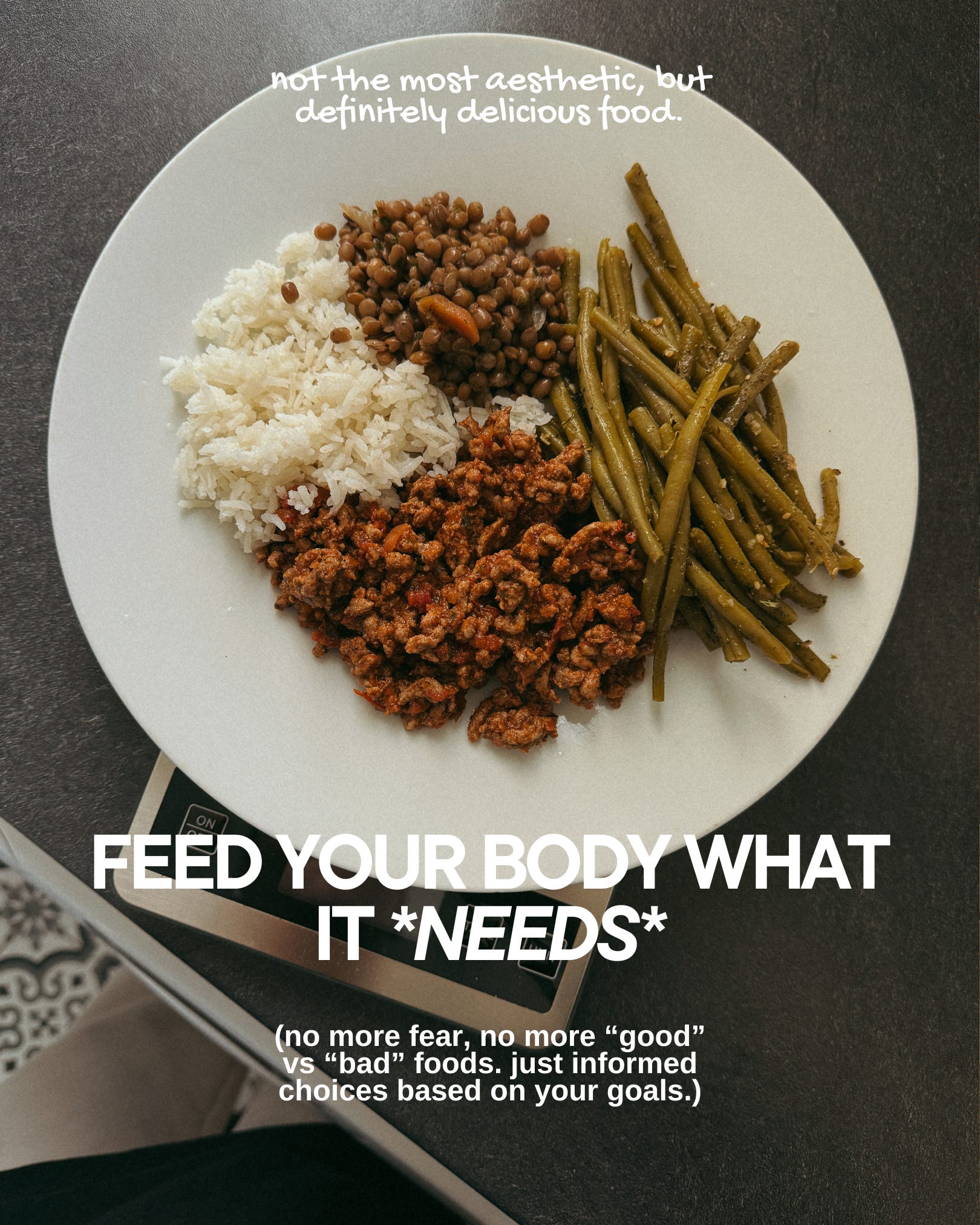
My prep strategy is what I call “semi-prep”: I cook 2 protein sources for 2-3 days (like lean ground beef and shredded chicken) plus one carb source (rice, pasta, or potatoes). I don’t prep everything because food goes bad. This gives me flexibility while ensuring I always have the basics ready.
quick meal hacks that saved my sanity:
Frozen vegetables are your friend. Not the ones pre-loaded with butter and sauces — just plain frozen veggies you can steam or stir-fry. Super simple and quick for days when you don’t have much time.
Roasted vegetables in batches. Quick and simple: roughly chop everything, add seasonings (garlic powder, herbs, olive oil, smoked paprika), and throw it in the oven for 30 minutes. You can make enough for lunch and dinner, just switch up the protein.
When you’re craving variety, get creative with your carbs. Swap your usual rice or pasta for a tortilla or naan bread. Load it with your prepped protein, veggies, a bit of shredded cheese and tomatoes, then pop it in the oven or air fryer for 10 minutes. You’ve got a delicious, quick meal that still fits your macros.
Eating for muscle growth doesn’t mean boring chicken and broccoli every day.
step 4: workout fuel made simple
Despite what supplement companies want you to believe, you don’t need special powders and potions around your workouts. Your body mainly uses stored glycogen (from the carbs you ate earlier) for fuel.
That said, if you train early morning or it’s been hours since your last meal, something quick can help. My go-tos: a banana, toast with honey, dried fruits, or a simple carb drink. Whatever your stomach can handle.
Post-workout: just eat your next regular meal within a reasonable time. The “anabolic window” is mostly bro-science. Your muscles aren’t going to disappear if you don’t slam a protein shake within 30 seconds of your last rep.
step 5: the only three supplements worth your money
You don’t need a medicine cabinet full of pills and powders. Here’s what I actually use:
Creatine: 5g daily, every day. Helps with strength and recovery. Cheapest and most researched supplement out there. Just buy the basic monohydrate, not the fancy versions.
Whey protein: Convenience thing for me. Sometimes hitting 120g of protein from whole foods is hard. A shake helps bridge the gap.
Caffeine: My pre-workout is called coffee. Sometimes I’ll have a pre-workout drink if I’m really dragging. That’s it.
Everything else is marketing hype. Save your money for actual food.
step 6: tracking that keeps you sane
I weigh myself weekly, looking at trends not daily fluctuations. If you want to get fancy, MacroFactor is an amazing app that adjusts your calories and macros based on your actual progress.
But the real indicator is progressive overload in the gym. If you’re getting stronger, you’re doing something right. If your lifts are stalling for weeks, you probably need to eat more.
step 7: the mindset shift that changed everything
The hardest part for me was overcoming the fear of eating more.
My first real bulk happened this year, between January and June, and I only had the courage to do it because I had a nutritionist who reassured me every step of the way. In six months, I achieved results I’d never seen before. Results that had eluded me for years because even when I was supposedly eating to gain muscle, my brain wouldn’t let me go all the way.
The fear is real. Every time the scale went up, part of me panicked. Every time my jeans felt a bit tighter, that old voice whispered that I was getting fat. But here’s what I learned: that temporary discomfort is the price of building the body you actually want.
Breaking free from the “eat less” mentality isn’t something that happens overnight. It’s a daily choice to trust the process, to feed your body what it needs, to believe that more food means more muscle, not just more fat.
making this work in real life
Here’s what makes or breaks your nutrition: can you actually stick to it?
Environment matters: If there’s ice cream in my freezer, I’m eating it. So I don’t buy it every week. I stock up on foods that support my goals and save treats for when I really want them.
Smart meal prep: Just enough to save time without getting bored. Having proteins ready means I can throw together a meal in 10 minutes.
Education beats rules: Once I understood why I needed certain nutrients, choosing foods became easier. No more fear, no more “good” vs “bad” foods. Just informed choices based on my goals.
Five years ago, I was scared of carbs, surviving on rabbit food, and wondering why I had no energy and no muscle definition despite working out constantly.
Today I eat more than I ever have, including plenty of carbs (gasp!), and I’m stronger and leaner than I was at 25. The difference? I finally learned to work with my body instead of against it.
Your body is not the enemy. Food is not the enemy. They’re partners in building the strong, healthy physique you want. Feed your body what it needs, and it will reward you with energy, strength, and yes, even those aesthetic gains you’re after.
This week, pick one or two things to try. Maybe track your food for a few days to see where you’re at. Or add an extra 20-30g of protein to your daily intake. Or prep two protein sources for the week. Small steps, but they add up.
This is the type of substack I've been looking for! I'm also a huge fan of MacroFactor and have found it so helpful in encouraging me to eat more. I can't imagine how helpful an actual coach would be!
I’m a great advocate for making sure your macros are balanced, but in a way that works for you.
Avaia was born from the very reason that we are all one of a kind.
Love to hear your experience. 🙏🏽✨